

Yangshuo
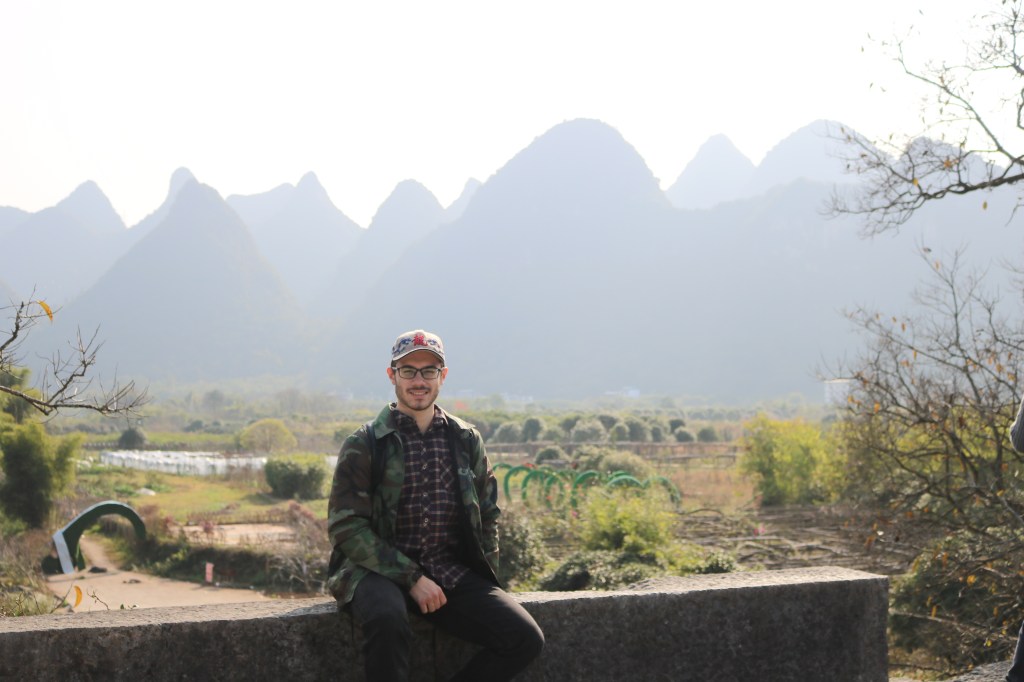
„Are we sitting in the right train?”, I asked my girlfriend as we were entering the train to Yangshuo. There weren’t any seats in the train, only “beds”. That’s why I was so confused. I booked seats, not beds! Chinese trains have different kinds of beds. There is the “hard sleeper” and the “soft sleeper” class. If you want to sleep “soft”, you’ll have to pay more. Only if it’s a very long trip over night, I would advise you to buy the “sleep” tickets. They are quite expensive. That’s why Chinese peasants buy the cheap ones and sit the night through.
Anyway, sitting on a bed with three other people is a quite unusual experience. It took us about 3 ½ hours to arrive in Yangshuo. What is Yangshuo and what is it famous for?
First, if you like hiking and nature, Yangshuo is the place to go. Second, you should try the different fish meals in Yangshuo. Sadly, Guangxi Province is not very famous for its cuisine. Third, Guangxi is a province of fishermen, farmers and artists. It is possible that even if you are not that familiar with Chinese paintings, that you have already seen paintings like these:
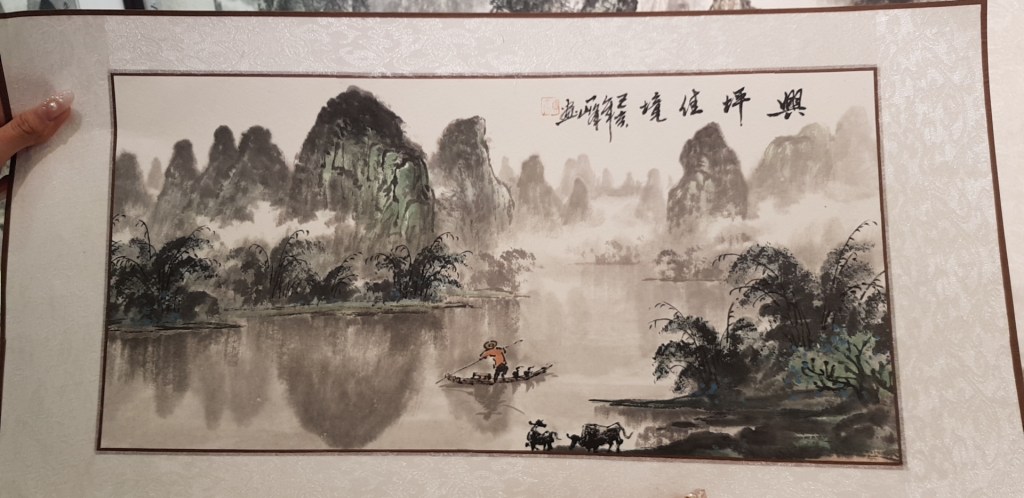
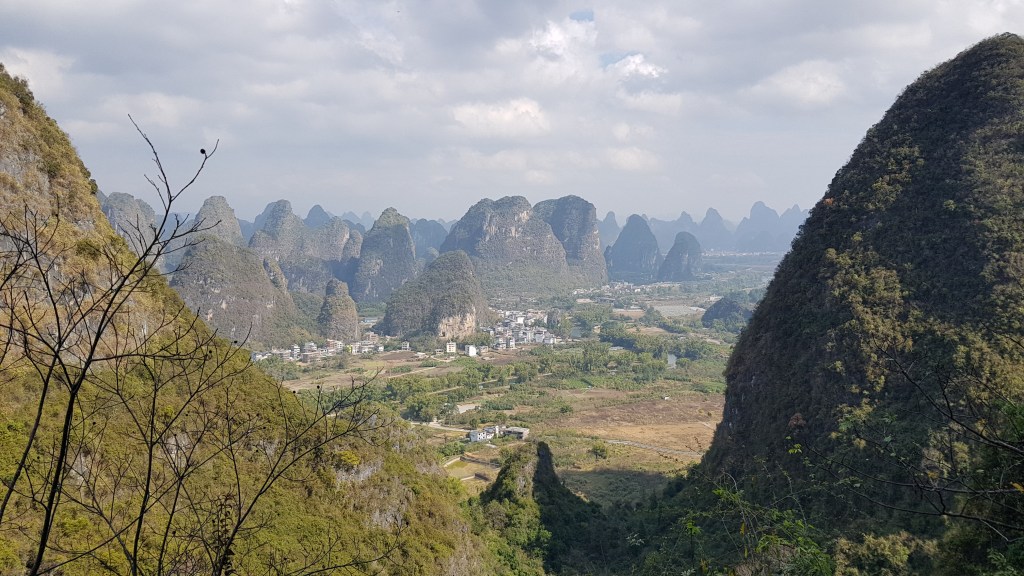
In the old days people just couldn’t take their phones out and do some quick snaps. So, to be able to preserve these beautiful landscapes for themselves and for others, they just drew it. This is my theory. To be honest, I have never seen such a breathtakingly beautiful scenery. All those mountains seem to be so mystical. Therefore, the first thing we did was hiking. We climbed a mountain right in the middle of the city of Yangshuo (It’s located in the Yangshuo park, Yangshuo gongyuan, 阳朔公园, and the starting point of the way up is a bit tricky to find) and enjoyed the view. In the middle of the climb we bumped into a stranger and he started a conversation telling us that he just broke up with his girlfriend. We didn’t know what to say. Patting his shoulder, I told him not to be too sad about it. I don’t think that I made it easier for him.
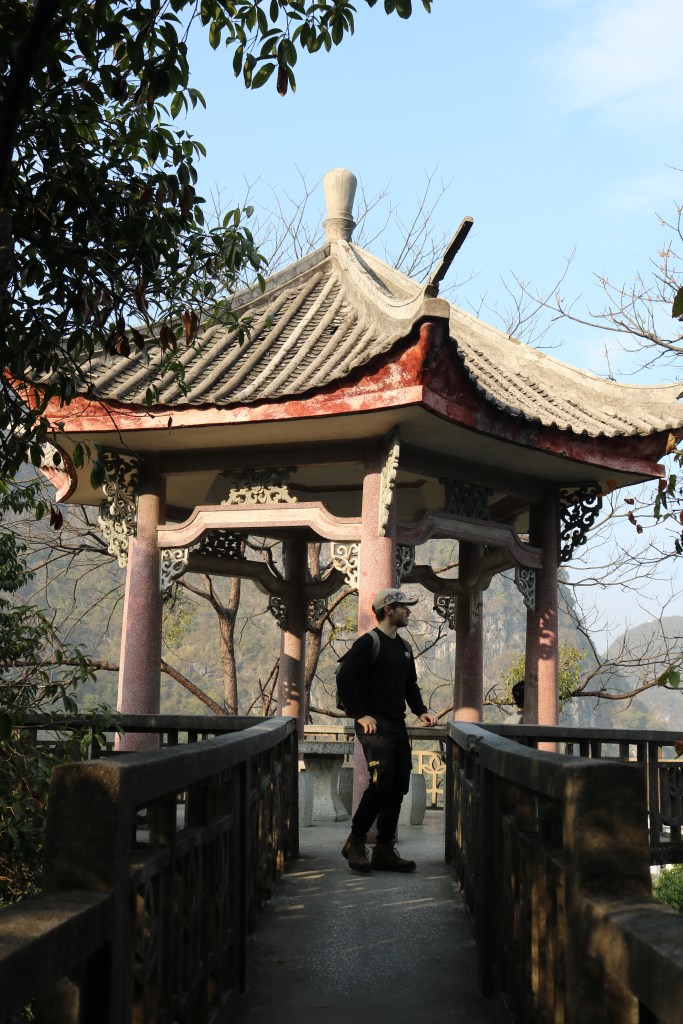
You know those limestone cliffs in England, don’t you? Here, they are everywhere, but not like in England right at the ocean. Our first thought must have been to enjoy them every second during our visit. We should stay up early in the morning and look at them all day long. They are truly terrific to look at. But as you all know, I like sleeping.
A very famous hill in Yangshuo is called Moon Hill. Be sure to check it and other climbable mountains out. It’s so beautiful to see all the mountains from the top! (There is a secret path up)
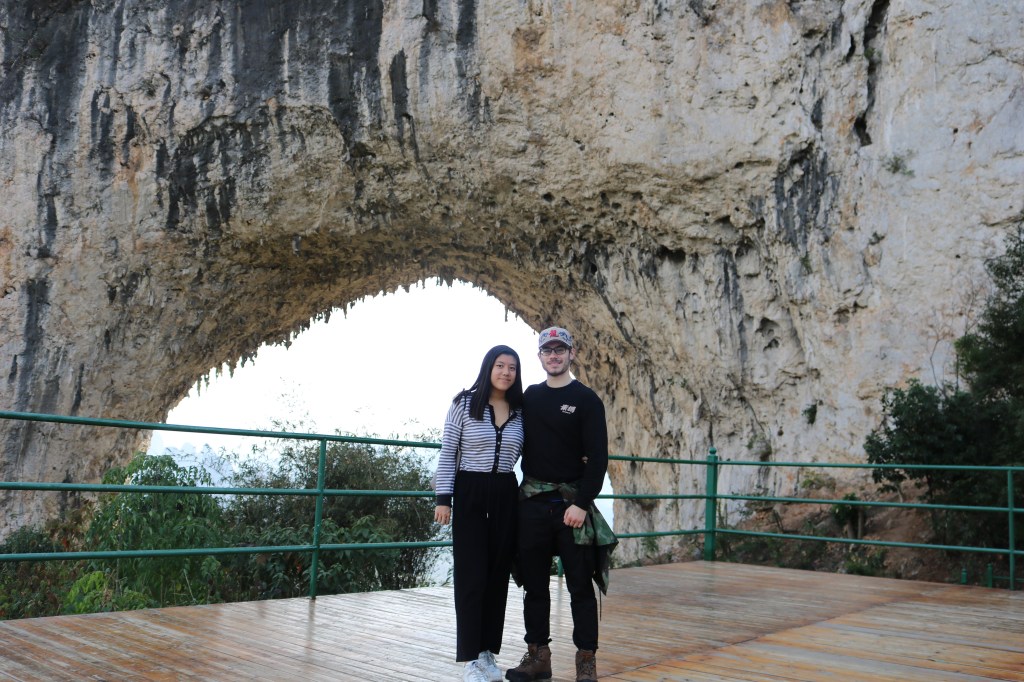
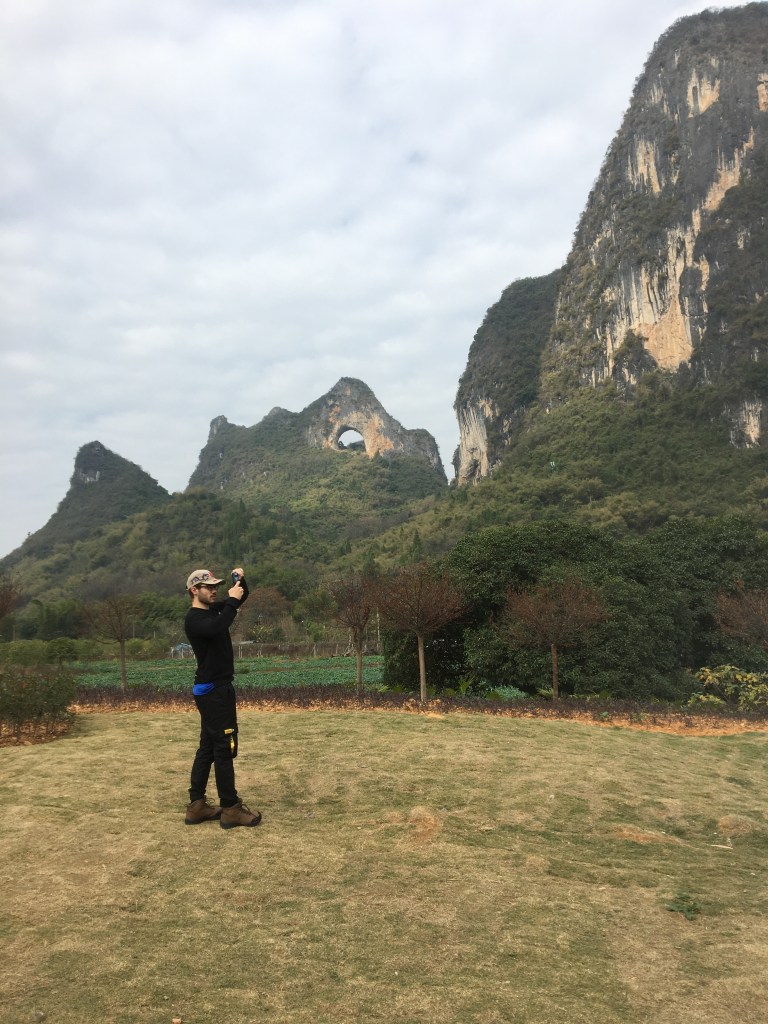
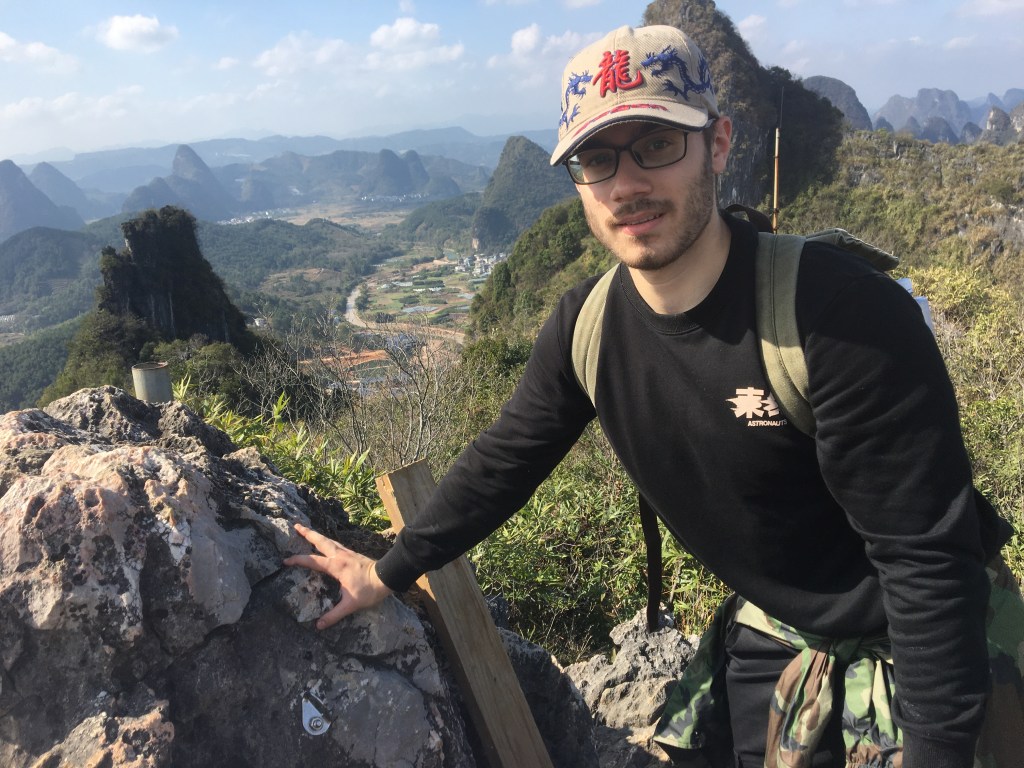

Afterwards, we went to eat some beerfish (which doesn’t taste like beer at all). It was quite delicious, but expensive, too. You should also try the water snails and frogs.
Then I had some problems with my neck again, so we decided to go to a nearby located pharmacy. I wasn’t expecting much but the pain instantly vanished. I was full of joy. There is a place in Yangshuo called West Street (Xijie – 西街). You should go there and have a look. This is the place with all the western style restaurants. There are more tourists and it’s more expensive there. Don’t forget to bargain when buying souvenirs for over 50 RMB.
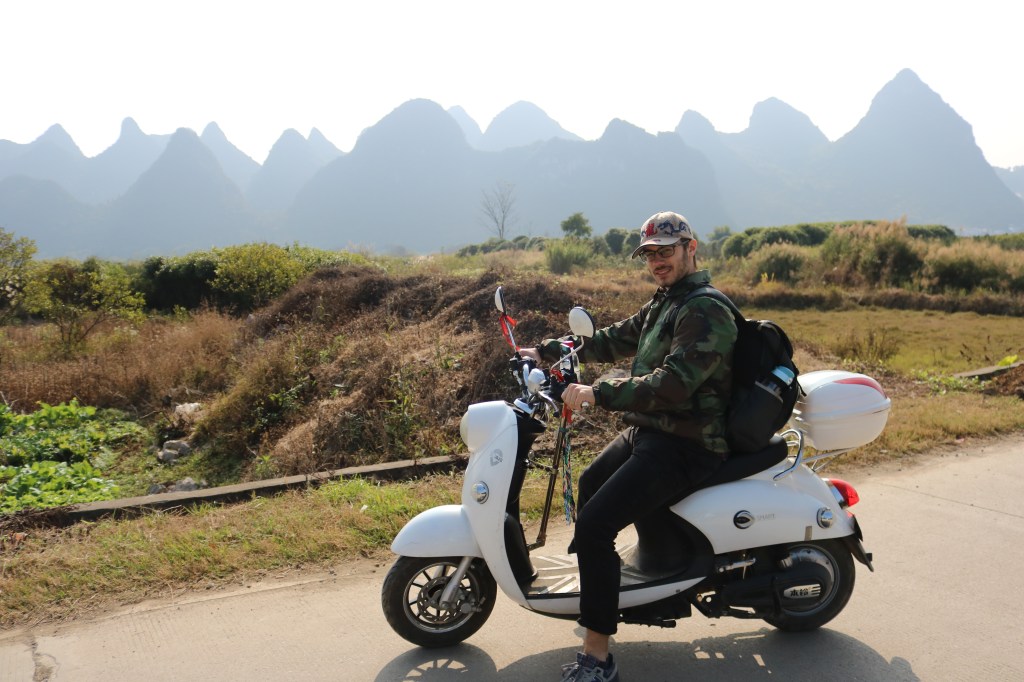
Everywhere in Yangshuo there are old cars, trucks and small lorries. They are loud, disgusting and driving very fast. So, be careful, especially, when you are driving a scooter, which brings me to my next point. You should consider renting a scooter or a bike. Usually, there are scooters and bikes available at almost every hostel or hotel. If not, don’t panic, every damn 50 meters you will find a place where you can rent them. And it’s so cheap. 10 or 20 RMB for a bike, and 50 RMB for a scooter. Why renting a scooter? Even if there is almost no elevation (YES! There is almost no elevation, although there are mountains everywhere. But the mountains are like needles rising up into the sky), you will be exhausted after all the hiking. The city of Yangshuo itself is not as interesting as you might think. All the interesting places are located around it. You need to be mobile and fast. So, the scooter is the best option you will have. Because all the scooters are electric, you need to rent gasoline ones to reach farer destinations. Even if you can’t ride a scooter, you can learn it in a few seconds. It’s almost as easy as riding a bike.
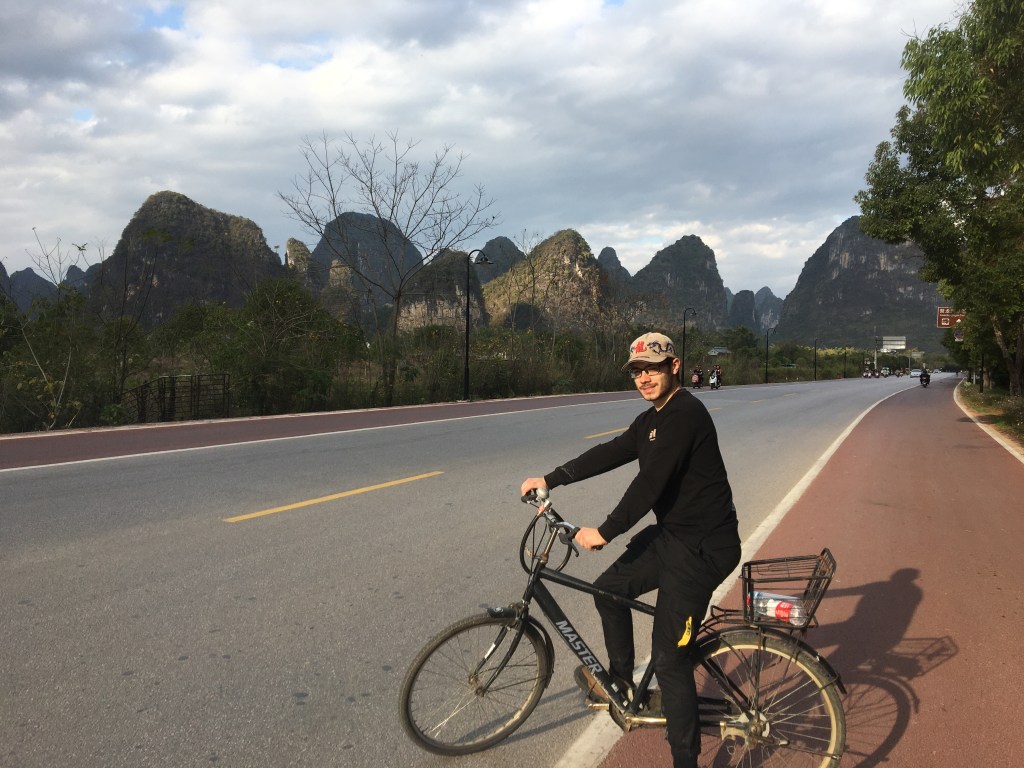
After bargaining for a nice and expensive painting on the bustling West Street in Yangshuo, we accidently bumped into our fellow student from our University. The next day we met him again and then again, but I will tell you later more about this crazy coincidence. Before I forget it, if you are travelling by using the “Lonely Planet”, not all the information is up to date, for example, we couldn’t find any night markets, and some restaurants and shops aren’t available anymore. Be ready to be disappointed. But do not be disappointed when not finding the right way up a mountain. Sometimes you just have to be patient about it.
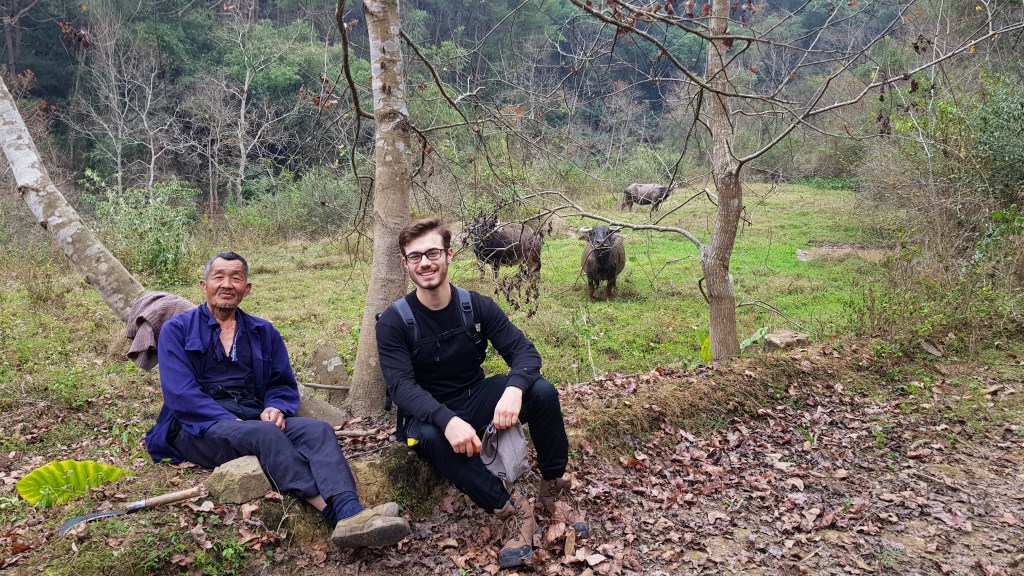
The next day we went on a big hike. I recommend you to visit Yangshuo and Guilin in the winter. There are less tourists. You are often even all alone by yourselves. But because of the lack of rain during this season, there might be less water and therefore some sights could be not that interesting anymore. Although we didn’t expect to see any water at the amazing waterfall near the village of Pubu Tang – 瀑布塘, we saw it on the last day of our visit in Yangshuo. The waterfall itself isn’t called Pubu Tang, this is the name of the village. The actual name of the waterfall is Hushan Pubu – 虎山瀑布 (tiger mountain waterfall). When visiting Yangshuo be sure to check out the outskirts and poorer regions of this county. It’s worth seeing how Chinese people live outside the big cities. China is so big and vast and with every day passing by I realise how much I’ve already learned about it and how much there is still to learn. On this day we also bumped into a farmer and his water buffaloes. Water buffaloes are a rare sight and we were so grateful to have had the chance to see them. All that they did was staring at us with their big curious eyes stretching their necks as if they wanted to look down upon us.
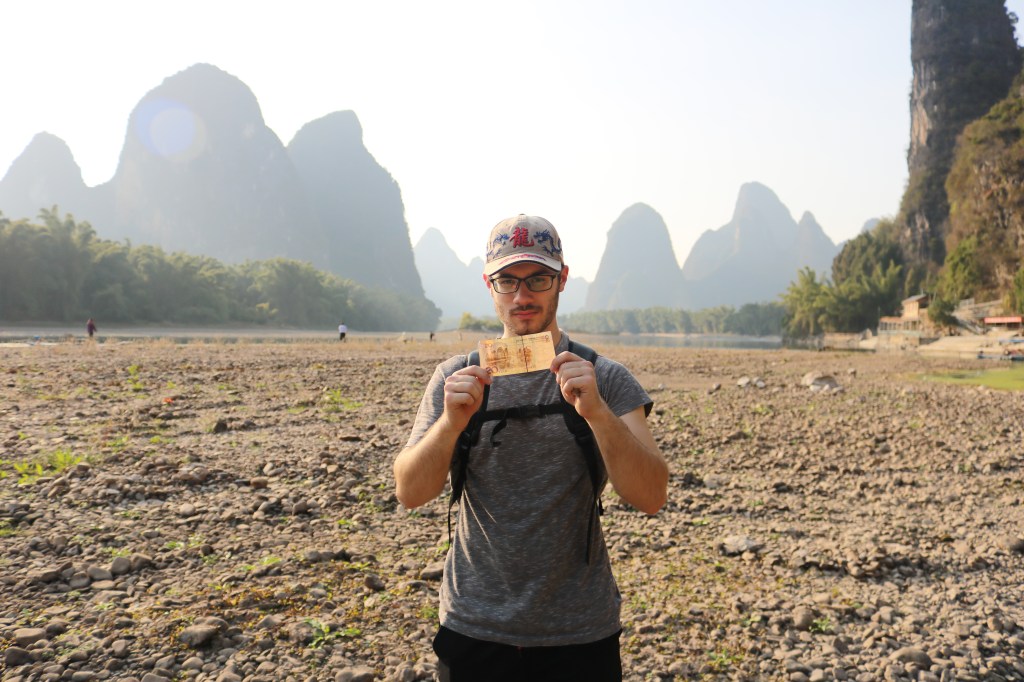
January is the driest season here in Guangxi, so, as we went to the old city of Xingping – 兴坪, we found a very dry riverbed of the Li River – Li Jiang – 漓江. But the 20 kuai/RMB view was still fascinating to see.

In the city of Xingping we accidentally bumped into whom again? – you guessed right – into our fellow student and – originally, my French roommate. Because I don’t live in the dorm, we haven’t had the chance to live together, so he told me he feels quite lonely sometimes. On the other hand, he enjoys living alone in private not paying much for his own room. Dorm fees are quite low here in China. Together, we did a terrific hike onto the mountain next to the city. In the evening we tried something special – caramelised Taro fruit. Try it out! It’s very delicious.
On the day before our last day we rent scooters for the first time. I didn’t know how to ride a scooter then. But the woman who gave us the scooters for rent was quite confident that I learn how to ride quickly enough. To be honest, I wasn’t expecting being able to learn it in a fraction of a second. My girlfriend and I found out that the best weapon on the road is honking. Chinese honk whenever they want to warn you that they are approaching, and you should be careful. And sometimes they are just honking because they are mad at you. Back in Germany I should try to forget this and other kinds of behaviour or I’ll be banned from operating a vehicle. Currently, I am driving like an asshole.
Back to the trip! We drove to sightsee old bridges. The most famous ones are the Yulong bridge – 遇龙桥,and the Fuli bridge – 富里桥. At the Yulong bridge you can buy a ticket for a nice bamboo raft tour. I think it’s worth the money, although it is not as adventurous as you might think. At the Fuli bridge, which is located not far away, you can take a nice walk through the fields and enjoy the beautiful scenery.
The last thing I want to mention about Yangshuo are the caves. Yes, there are a lot of caves, not only open ones which can be seen from outside, but also caves right inside the mountains. You might have heard about the stalactite caves in Slovenia. There are also stalactite caves on Yangshuo. They are so massive and beautiful. The Chinese have a special way to present those caves to the tourists. They are using bright light in different colours to light the whole cave up. Then, at the end of the cave, there are hot springs and mud baths in which you can relax. These kind of tourist attractions are very interesting to visit. The construction of the cave which we visited though, wasn’t finished, yet, and at the very end of it, there was ear-piercing construction going on. The best caves are Gold cave – 金水岩, Silver cave – 银水岩 and the Dragon cave – 龙水岩.

Guilin
Guilin is neither a very big nor the capital city of Guangxi Province, but it is a great spot to start your travels from. A very famous travel destination is the Longji Rice Terraces (龙脊梯田 – Longji titian). I recommend booking a tour bus or just a bus to the rice terraces. There are no trains going this way. We took the tour bus and our first stop were the Yao villages. The Yao are one of the 56 officially recognised ethnic groups in China. 55 of them are minorities. The one left is the Han ethnic group which is also the biggest ethnic group in China. Over 90% of China’s population is ethnically Han. That is why Chinese is also called “The language of the Han” (汉语 – Hanyu). Although there are countless dialects spoken throughout China, the languages of the minorities differ even more. Some Chinese dialects I wouldn’t even call dialects anymore. For example, there is such a great difference between Mandarin and Cantonese (which is widely spoken in the south of China) that Chinese who don’t speak it can’t understand a thing. I would even compare it to the differences between Dutch and German. Some old people speak a mixture of Mandarin and Cantonese. That is quite confusing! I thought only people in Hongkong are speaking that much Cantonese, but in Guangzhou (the capital city of Guangdong province, also known as “Canton”) it’s the same! Sometimes I wonder why I even bother to learn Mandarin…
The same counts for Guangxi province. People here speak Guiliuhua – 桂柳话. Thus, the people in the Yao minority speak their own Yao language. During our visit to their village we saw some traditional dancing and hair combing. What do I mean by “hair combing”? The Yao women have a tradition of growing their hair and not cutting it. Therefore, their hair is very long, and it has to be combed regularly. Whenever a hair falls out, they will keep it and make a new braid out of it. Then they connect this huge braid to their hair in some way. At the end they bind everything together around their head and using a kind of hat to keep the hair in this position. Just look at the pictures:
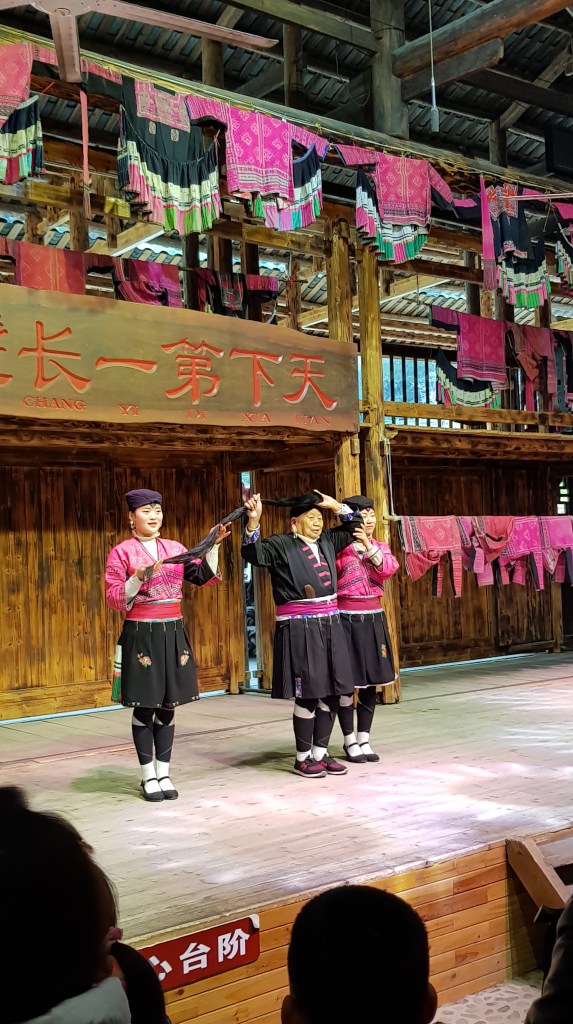
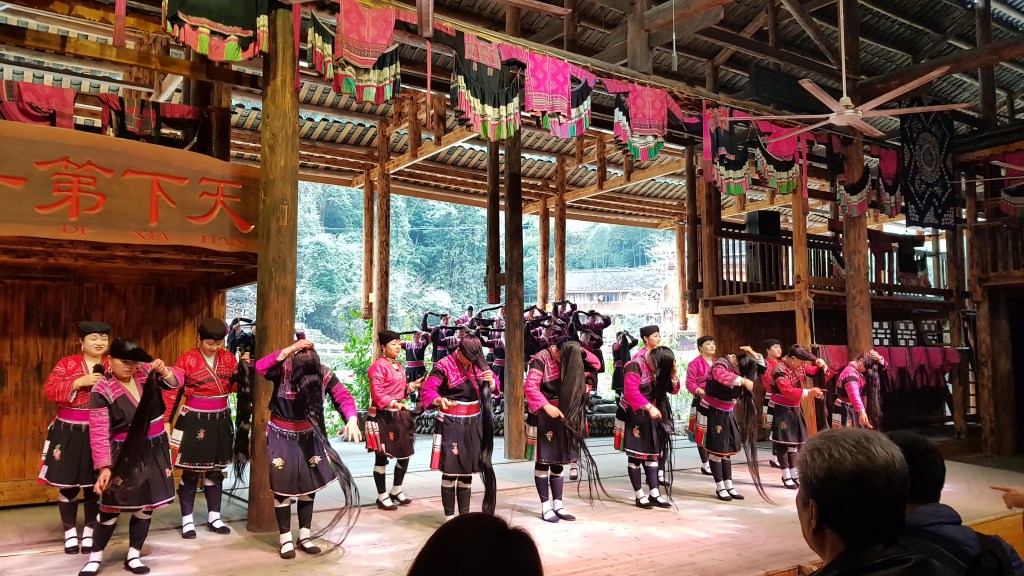
At the end I was even invited to dance with them. The Yao minority was not the only minority which we were able to meet during our travels in Guangxi.
Back to Guilin! Guilin is a nice and small city. There is enough to do to spend a few days. Although Zhuhai is bigger, Guilin is a more liveable place than Zhuhai, I would say. There are mountains in the city you can climb, and, in the evening, you can go to see the two rivers and four lakes (两江四湖). It’s a boat cruise around the city. We did it in the morning, because it’s more expensive in the evening with all the beautiful lights turned on. There are two beautiful Buddhist pagodas which are worth visiting (双日月塔). One of the them represents the moon, and the other one the sun. They are connected by a tunnel you can walk through. You can climb to the very top of both pagodas. Then there are beautiful streets and night food courts north of the pagodas and north of the square under which you can find a big and cheap shopping mall. Walking is even more convenient than taking the bus in Guilin.
Another travel destination in Guilin is the elephant mountain – 象山. It’s less interesting than I thought. Some people think that it looks like an elephant, others think it looks like a rat. By the way, there are a lot of rats everywhere here in Guangxi, especially, on the countryside. The saddest thing about the beautiful countryside is the waste. You can find plastic almost everywhere. But there are also good news! The Communist Party of China declared a new war on the use of plastics. In another 5-year plan its ambition is to minimise or even eradicate the use of it. The biggest problem about this is that the Chinese love to use plastic bags everywhere and everytime.
We are trying to live an ecologically sustainable life in China. That also means minimising the use of plastic. Sometimes it’s harder than you think it is. When buying food we often have to repeat ourselves thrice that we don’t need a plastic bag. We get even mad at the shopkeeper sometimes. And then, after you gave them your ecological friendly bag, they suddenly start to put the more vulnerable stuff into small plastic bags! It’s a nightmare.
Yesterday, I saw a kid hiding his plastic bag in some place (I don’t know where the hell he got that idea from?!). I confronted him, told him to remove his plastic bag, because it’s obviously trash. His mother told him the same. Thank God he removed it. Now, I remember how my father used to tell me those stories from the time he was still a kid in the Soviet Union. Because products were rare and nobody knew when new stuff was going to arrive, everybody used to have a bag in his pocket. Whenever something new arrived and you saw it on your way home, for example, you could directly go the market and buy it using your nice bag, which definetly came in handy.
Now the Chinese were also used to that kind of life. Because there were only materials like wood, metal and glass, which are not harmful for the environment. Usually they just threw it away somewhere. But as plastics one day arrived, everything changed. They did the same with plastic waste and threw it at the same place where they were always throwing stuff away – right into mother nature. Of course, there was nobody to teach them. From my experience, Chinese are always willing to learn new things. It might be hard to get the new anti-plastic regulations through, but, eventually, it will succeed.
We also visited an old village called Jiangtouzhou – 江头州. The Lonely Planet recommends it. In the winter there is nothing really special there though.
To sum up our travels in Guangxi:
Guangxi’s north is a very special place. The landscape is so terrific. I have never seen something like this in my life! Guilin is a small but interesting city, too and you can also spend time here or use it as your starting point for further adventures.
Pictures were taken by Christy Man 🙂
 SouthernChinaTraveller's Blog
This is great! Thanks for posting. Let me know if you’re interested in a free blog-makeover, I’m helping out growing blogs for free and think you’re a great candidate! olivia@blogerize.com
LikeLiked by 1 person